
Leshan Giant Buddha
Located in Leshan City, Sichuan Province, about a 1-hour high-speed train ride from Chengdu, the Leshan Giant Buddha (Leshan Dafo) is the largest stone Buddha in the world and a UNESCO World Heritage Site. Carved into a cliff face at the confluence of three rivers – the Minjiang, Dadu, and Qingyi – this magnificent statue has watched over passing boats and pilgrims for over 1,300 years. This guide covers the Buddha’s history, Buddhist significance, two ways to visit (walking and boat tour), and practical travel tips.
History of the Leshan Giant Buddha
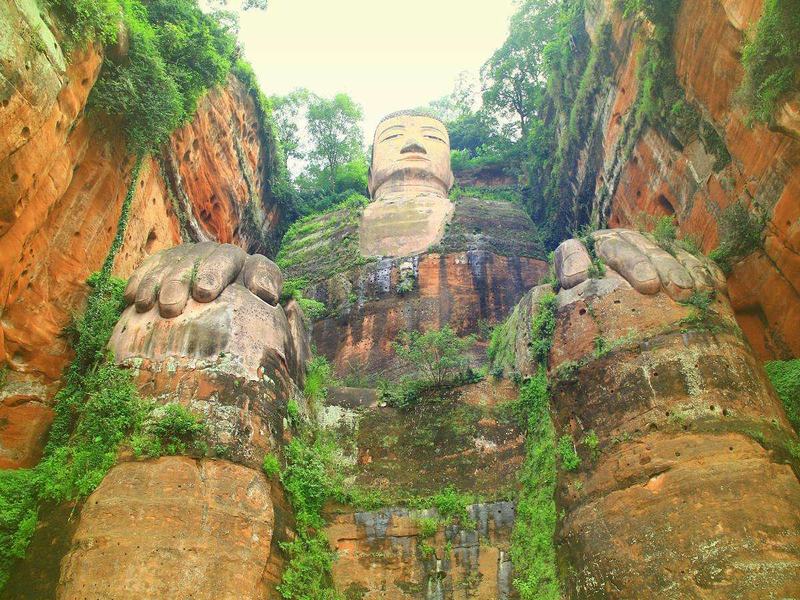
Construction of the Leshan Giant Buddha began in 713 AD during the Tang Dynasty, led by a Buddhist monk named Haitong (Sea Passage). Haitong hoped the Buddha would calm the turbulent waters where three rivers met, which had caused countless shipwrecks. After raising funds for the project, Haitong allegedly gouged out his own eyes to prove his sincerity to greedy officials who demanded bribes.
The project continued after Haitong’s death and was later completed by his disciples and local officials. The statue was finally finished in 803 AD – a total of 90 years of continuous work. The giant Buddha remains remarkably well-preserved, thanks to an ingenious drainage system hidden in the hair, ears, and collar.
Key dimensions (breathtaking scale):
•Height: 71 meters (233 feet) – taller than the Statue of Liberty (93 feet from heel to head).
•Shoulder width: 28 meters.
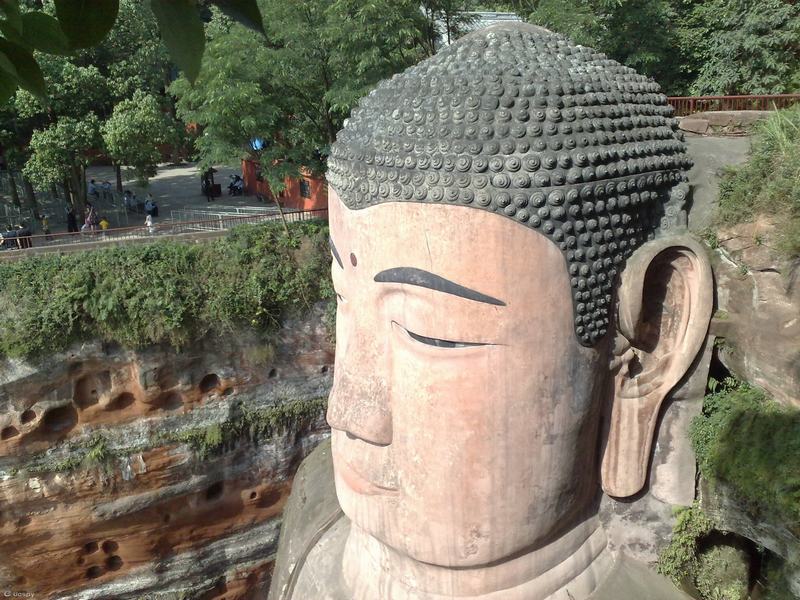
•Head length: 14.7 meters, with 1,021 coiled buns of hair.
•Ear length: 7 meters – large enough for a person to stand inside.
•Instep width: 8.5 meters – over a dozen people can sit on each foot.
•Toenail: 1.6 meters wide.
Buddhist Culture & Significance
The Leshan Giant Buddha depicts Maitreya (the Future Buddha) , a bodhisattva who will appear on Earth to achieve complete enlightenment and teach the dharma. In Chinese Buddhism, Maitreya is often depicted with a serene, benevolent expression – exactly as seen on the cliff face.
The Buddha sits with hands resting on his knees (the bhumisparsha mudra – earth-touching gesture) and gazes calmly across the turbulent river confluence. For over a millennium, local Buddhists believed the Buddha’s presence tamed the dangerous currents. Interestingly, after the statue’s completion, the rocks carved away and deposited into the rivers actually altered the water flow, making navigation safer – a practical miracle.
Surrounding the Buddha are two large stone guardians carved into the cliff walls, along with hundreds of smaller Buddhist carvings and niches. The nearby Lingyun Temple (Lingyun Si) and Wuyou Temple (Wuyou Si) add to the sacred atmosphere.
Feng Shui and Spiritual Protection: According to Chinese Buddhism and folk beliefs, the Buddha faces southeast – directly toward the point where the rivers converge – symbolizing protection, calm, and the taming of chaotic energy.
Two Ways to See the Giant Buddha
Visitors have two distinct ways to experience the Leshan Giant Buddha: walking the cliffside plank road (for an up-close, immersive view) or taking a sightseeing boat (for the full panoramic perspective). Most travelers do both, but if time is limited, here’s how to choose.
| Feature | Walking (East Gate Entrance) | Boat Tour (Leshan Port) |
|---|---|---|
| Perspective | Up-close – see details, stone carvings, hair coils | Full panoramic – see entire Buddha from river level |
| Experience | Walk down the Nine-turn Plank Road hugging the cliff | Relax on deck, take wide photos without crowds |
| Crowds | Can be very crowded (long queues for the plank road) | Usually shorter waits, smoother experience |
| Time needed | 2–4 hours (including entry, queue, Lingyun Temple) | 30–40 minutes (including boarding and ride) |
| Physical effort | Moderate – many stairs, narrow path | None – just sit or stand on the boat |
| Best for | History lovers, pilgrims, photographers wanting detail | Families, elderly, travelers short on time, full-body shots |
Option 1: Walking the Plank Road (Close-up Experience)
The most classic way to see the Buddha is to enter from the East Gate (or North Gate) of the scenic area, walk through the Lingyun Temple complex, then descend the famous Nine-turn Plank Road (九曲栈道) carved into the cliff face. The path zigzags down beside the Buddha’s right side, allowing you to stand at the Buddha’s feet and look up – an awe-inspiring moment. You then climb back up via the left side.
Walking route summary:
-
Enter scenic area → Lingyun Temple → viewing platform (Buddha’s head level).
-
Queue for Nine-turn Plank Road (can be 1–2 hours on holidays – go early morning or late afternoon).
-
Descend slowly (tight steps, one direction, spectacular close-up views).
-
Reach the bottom – stand at the Buddha’s feet (8.5-meter-wide instep).
-
Climb back up via the left path → exit or continue to Wuyou Temple.
Ticket price (walking): Approximately 80 RMB (subject to change). Includes Lingyun Temple and Wuyou Temple.
Option 2: Sightseeing Boat Tour (Panoramic Experience)
For a complete view of the Buddha and the three-river confluence, a boat tour is unbeatable. Boats depart from Leshan Port (near the city center) or from the Buddha Square Pier near the scenic area. The boat slowly cruises past the cliff face, stops directly in front of the Buddha, and allows passengers on deck to take wide, unobstructed photos.
Boat tour details:
• Duration: ~30–40 minutes round trip.
•Ticket price: ~70 RMB (subject to change).
•Boarding points: Leshan Port (close to city center) or the scenic area’s riverside pier.
•Best time: Mid-morning or late afternoon for softer light.
•Note: Boats run year-round but may be suspended during extreme weather (heavy rain, fog, or high water levels – check before going).
Many visitors combine both: boat first (for context and the iconic “full Buddha” photo), then walk the plank road (for the immersive experience).
Practical Travel Tips & Itinerary
Classic 1-Day Itinerary from Chengdu:
•Morning (8:00–9:00): High-speed train from Chengdu East/South to Leshan Station (approx. 1 hour, ~55 RMB).
•9:00–9:30: Taxi or bus from Leshan Station to the Giant Buddha scenic area east gate (20 minutes).
•9:30–12:30: Walk the plank road – explore Lingyun Temple, descend Nine-turn Plank Road, view the Buddha from below, climb back.
•12:30–13:30: Lunch nearby (try Leshan famous food – Leshan Tihua Tofu and Qiaojiao Beef.
•13:30–14:00: Head to Leshan Port for boat tour.
•14:00–14:45: Boat tour for full panoramic photos.
•15:00–16:00: Optional – visit Wuyou Temple or Moyai Statues nearby.
•16:30–17:30: Return to Leshan Station → high-speed train back to Chengdu.
Getting There:
•By high-speed train (recommended): From Chengdu East or Chengdu South to Leshan Station (1 hour). Then take taxi (15–20 minutes, ~20 RMB) or bus K1/3 to Giant Buddha scenic area.
•By long-distance bus: From Chengdu Xinnanmen Bus Station to Leshan (2 hours).
•By car: Drive from Chengdu (about 1.5–2 hours on G0512 Expressway).
•Private car: Available if you book a tour package that includes Leshan Giant Buddha.
Best Time to Visit:
•Spring (March–May): Mild weather, blooming flowers.
•Autumn (September–November): Clear skies, comfortable for walking.
•Avoid: Chinese national holidays (May Day, National Day Oct 1–7) – crowds are extreme; queue for plank road can exceed 3 hours.
•Early morning (8:00 AM opening) or late afternoon (3:00 PM) – fewer crowds and better light for photos.
What to Bring:
•Comfortable walking shoes (many stairs).
•Hat, sunscreen, water (little shade on the plank road).
•Raincoat if rainy season (June–August).
•Cash or mobile payment (WeChat/Alipay – cards not widely accepted at food stalls).
•Camera/phone with wide-angle lens for the boat tour.
Where to Eat in Leshan:
Leshan is famous in Sichuan for its delicious street food:
•Qiaojiao Beef – a spicy beef soup with herbs, eaten with dipping powder.
•Tihua Tofu – silky soft tofu in chili oil.
•Leshan Grilled Pork Skewers – sweet and savory.
•Ye’er Ba – steamed sticky rice rolls wrapped in leaves.
Best food streets: Dongdajie (East Avenue) and Zhanggongqiao (near the Buddha scenic area).
Nearby Attractions:
•Wuyou Temple (included in the 80 RMB ticket) – a quieter temple built into the hill above the Buddha.
•Dongpo Pavilion – dedicated to Su Dongpo, a famous Song Dynasty poet.
•Leshan Old Town – walk along the riverfront at night.
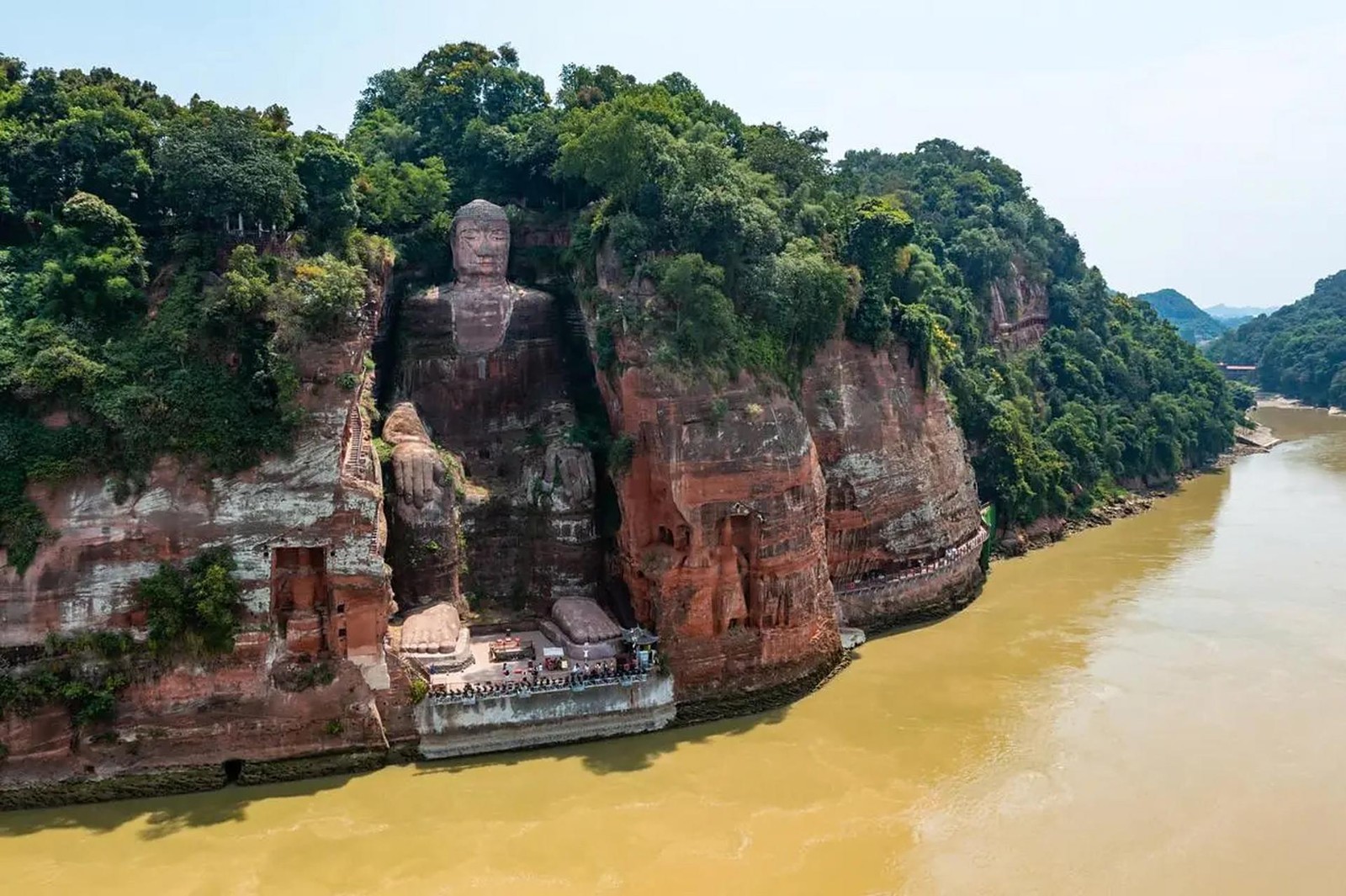
The Leshan Giant Buddha is an unforgettable blend of faith, engineering, and art. Whether you choose to walk the cliffside plank road for an intimate encounter or take a boat tour for the sweeping panoramic view – or both – you will witness one of the world’s most extraordinary monuments. Plan for a full day, avoid peak holidays, and don’t leave without trying Leshan’s famous beef soup.